Engineering — 2026
BUNG Gruppe: website relaunch with Astro
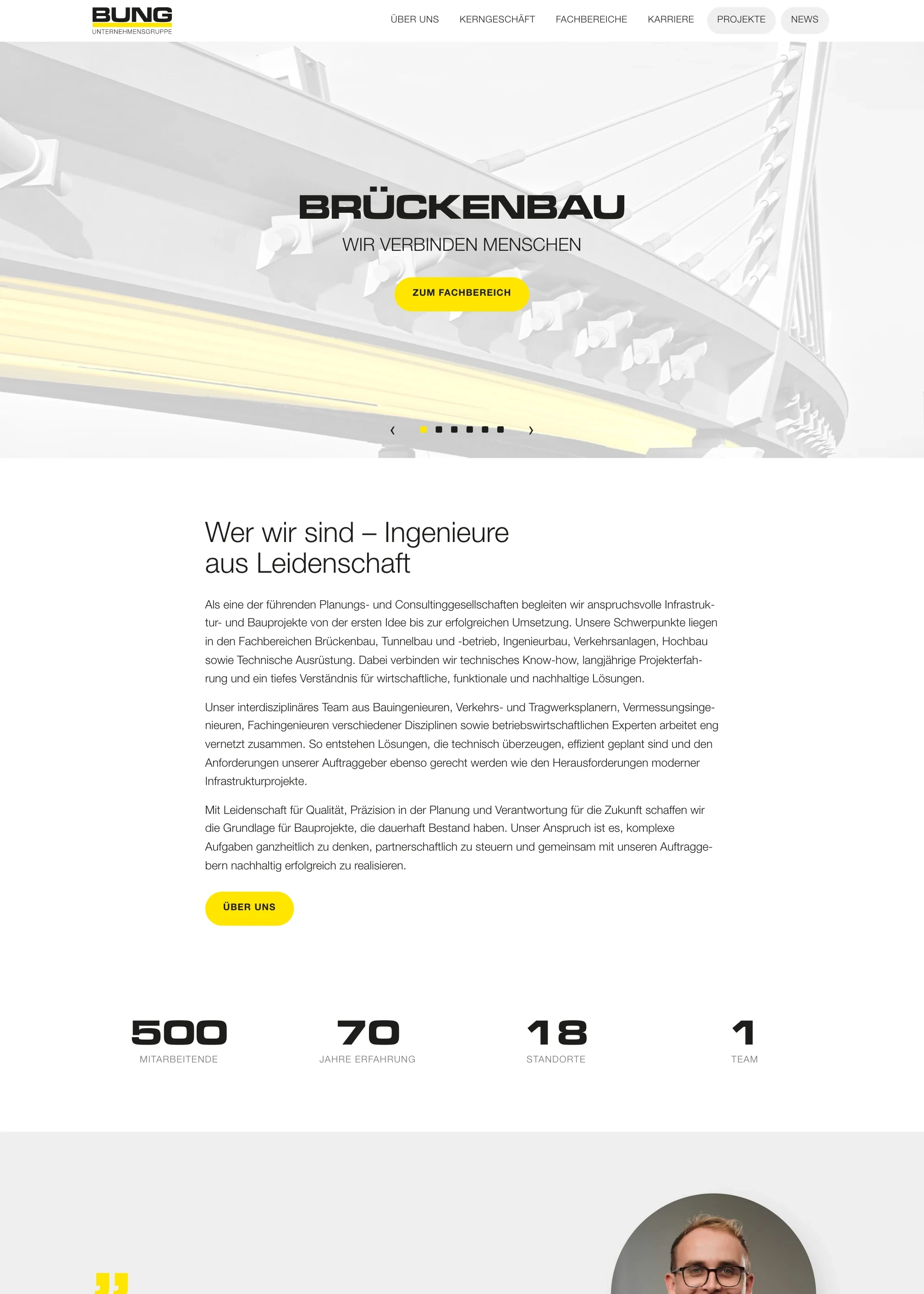
A new website for BUNG Gruppe and its planning and engineering firms: I moved everything from a WordPress network over to Astro, including a custom content management system. The whole group with all its reference projects in one structure – a huge undertaking. Now the site is really fast, and the marketing team looks after projects and news themselves.
The starting point: a website-builder site and a WordPress version
BUNG Gruppe from Heidelberg advises on, plans, inspects and monitors construction projects: bridges, tunnels, transport infrastructure, building construction and civil engineering. Until mid-September 2026, the public site bung-gruppe.de was still running on the Jimdo website builder, having grown over the years and been maintained by hand, page by page. Some projects appeared more than once, and several of the group’s domains pointed to the same site.
Meanwhile, we at stark.marketing had been building a new version in WordPress since early 2025, with Divi and a project database in which the marketing team was already maintaining the reference projects themselves. It was never published. This was exactly what the new website was now to be built from: the whole group in one structure, with its companies, core businesses, disciplines, services, reference projects and named contacts.
My part
On this relaunch, everything was down to me: the audit and recommendation, data model and migration, website and content management system, server, redirects, the technical documentation for the data protection officer and training the editorial team. We carried the design over from the WordPress version and sharpened it up for mobile and for contrast, for example with a menu shown as a card that displays an image of the page it leads to.
Why Astro and Payload instead of WordPress
The idea behind it fits into one sentence: one place for the content, many pages built from it. In the WordPress version, the editors had to piece together every project description in Divi by hand. Now the content lives as records in Payload, an open-source content management system that I tailored to BUNG: labelled in German, with roles for editors and administrators, and with a version history. It runs on its own server in Germany.
Astro turns this data into finished pages. When someone opens a page, there’s no database and no PHP running; the pages arrive as ready-made files via Cloudflare. The marketing team enters a project once, as fields and blocks rather than as a layout of its own, and it automatically appears in the right project lists and in the filter by core business and discipline. Because each company is its own record, every subsidiary could later get its own website from the same data.
Moving from WordPress: projects, services, images
What moved over were the projects, the services, the companies, the news and the images that go with them. The WordPress API was locked, so I used the perfectly ordinary export. It has just one catch: it leaves out relationships, such as which services belong to which project. But those were hidden in the titles of inconspicuous intermediate entries, and from them I was able to rebuild the whole web of links between projects and services in full.
Along the way, every image was given a name that says what it shows, such as projekt-b-33-tunnel-hegne instead of a number. And before anything goes live, a tool checks every page: whether the links, images, videos, blocks and even the bold text are all still there. If the check fails, the previous version stays online.
Old URLs, new pages
With every relaunch, the question comes up sooner or later: what happens to our old URLs? At BUNG, they redirect to the matching new pages, so that no bookmark or search engine link ends up at a dead end. The Jimdo site could no longer be accessed, so I reconstructed its URLs from the old sitemap and the Internet Archive. Wherever the structure also appears on the new site, old reference pages lead straight to its project page.
If the marketing team changes the URL of a project or a news item today, the redirect is created automatically. And all of the group’s domains lead to the one website.
Publishing in under a minute
For the editors, it’s simply ‘Publish’. Behind the scenes, the server rebuilds the site, checks it and delivers it, all or nothing, in less than a minute. A status bar in the content management system shows where the rebuild is at. Drafts don’t trigger anything; there’s a protected preview for them. And if the content management system ever goes down, the website still stays online.
That comes at a price, and it was in my recommendation from the start: the editors have to learn a new interface, and a change only shows up after the rebuild, not in the same second. To make getting started easier, I walked the editors through the system and rewrote its help texts in everyday language.
Fast, accessible and privacy-friendly
The new site has been live since 16 September 2026, a good two weeks after the audit. The switch was made with a DNS record and no maintenance window; the old site stayed online right up to the switchover.
Because the pages are already built and waiting, they appear practically instantly, and the CSS and JavaScript are so lean that even an older phone doesn’t break a sweat. The site follows WCAG 2.2 (level AA), with strong contrast, visible focus indicators and a text list alongside the location map, designed with keyboard and screen reader users in mind too.
It’s privacy-friendly too: until consent is given, it doesn’t set a single cookie or load anything from third-party servers. The fonts are served by the site itself, and YouTube videos only load after a click.
And since then
After the launch, things carried straight on: the editors got a preview for drafts, and changed URLs now redirect by themselves. The content management system’s server is looked after by stark.marketing, with updates, hourly backups and monitoring. The principle behind it: nothing in this set-up ties BUNG to us.
- Services
- Relaunch, Development, Content management system
- Year
- 2026
- Industry
- Engineering